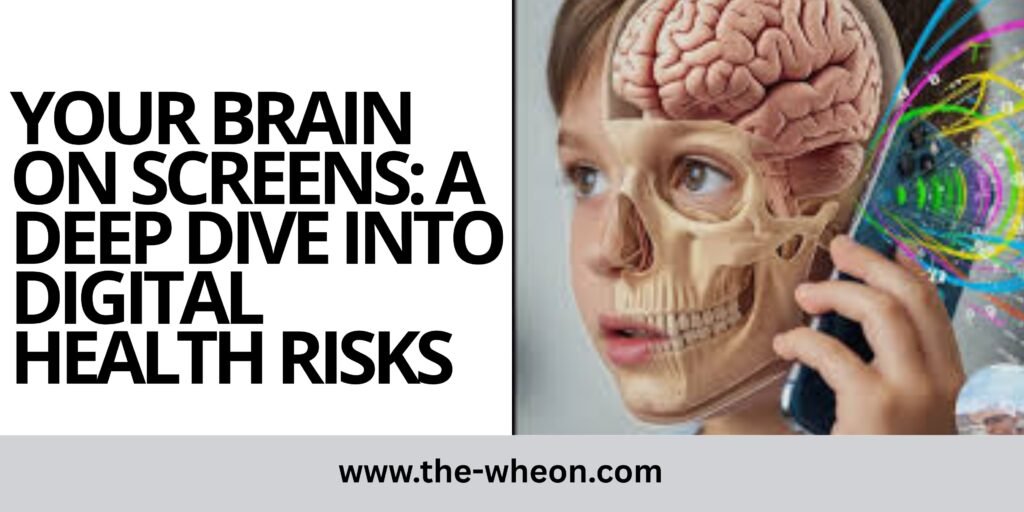
In the digital age, our brains are never truly “offline.” Smartphones, tablets, laptops, and other screens saturate nearly every facet of daily life — from work and school to leisure and socializing. While technology has delivered tremendous benefits, mounting research increasingly warns of the hidden costs: the impact of excessive screen time on cognition, mental health, and neurological well-being. At wheon.com, our mission is to unite deep science with practical insight. In this article, we explore what happens to your brain on screens and how to navigate digital health risks with clarity and balance.
The Neuroscience of Screen Exposure
The human brain is shaped by experience. During childhood and adolescence — periods of intense neural development — daily engagement with digital media can influence the pruning and strengthening of neural circuits.
One MRI study of preschoolers found that high screen use correlated with thinner cortical thickness and reduced depth of sulci (the grooves in the brain), particularly in regions tied to attention, language, social perception, and reading skills. In effect, the brain regions responsible for complex thinking may under-develop when overstimulated by low-depth digital input.
Other research links heavy screen use to altered white matter integrity, which can undermine efficient connectivity between brain regions. Over time, habitual multitasking, rapid switching between apps, notifications, and stimulus-rich media may blunt the ability to sustain deep focus, degrade memory consolidation, and stress executive functions such as planning and impulse control.
Psychological & Mental Health Dimensions
Beyond structural changes, screens influence emotional health. Excessive use has been associated with elevated rates of anxiety, depression, social withdrawal, and reduced self-esteem. Particularly among adolescents, screen addiction or compulsive digital behaviors — such as doomscrolling, binge consumption, or constant checking — correlate with negative mood and lower psychological well-being.
Several studies emphasize that it’s not purely the amount of screen time, but how we use our devices. Passive scrolling, algorithmically curated feeds, and feedback loops of “likes” can hijack the reward systems in the brain, reinforcing compulsive behavior.
Furthermore, using screens late into the evening often disrupts sleep. Exposure to blue light from devices suppresses melatonin secretion, delaying sleep onset and reducing time spent in deep REM sleep — a critical phase for memory consolidation and emotional regulation. Poor sleep in turn exacerbates cognitive fatigue, mood dysregulation, and attentional lapses, creating a vicious feedback loop.
Risks Across the Lifespan
Children & Adolescents
Young brains are particularly vulnerable. In early childhood, screens may displace active play, social interaction, and imaginative exploration — all crucial for healthy neural growth. In adolescents, high screen use has been related to weaker academic outcomes, attention difficulties, and emotional instability.
Adults & Older Adults
While many concerns focus on youth, adults are not immune. Chronic multitasking and deep dependence on screens can degrade attentional stamina, working memory, and cognitive control in adulthood. Some research, however, suggests that purposeful, cognitively engaging digital use (e.g. educational content, creativity tools, social connection) may have neutral or even beneficial effects on mental agility, though boundaries remain essential.
Common Mechanisms of Digital Brain Strain
To understand how screens influence brain health, it helps to examine some key mechanisms at play:
- Sensory Overload & Dopamine Hijacking
Rapid visual changes, infinite scrolling, and variable rewards (likes, notifications) can overstimulate dopamine pathways, pushing the brain toward addictive loops. - Attention Fragmentation
Habitual switching between tasks and apps can weaken our capacity for sustained attention. Over time, deep focus becomes harder to reclaim. - Memory Offloading
Relying heavily on external devices (e.g. Google) for data retrieval encourages the brain to store fewer facts, undermining long-term memory consolidation. - Sleep Disruption
Blue light and mental excitation delay sleep onset and reduce restorative sleep phases. Memory, emotional regulation, and neural “housekeeping” suffer as a result. - Neglect of Holistic Stimuli
Real-world experience brings multisensory, unpredictable, and emotionally rich stimuli. Screens tend to offer impoverished, repetitive input — reducing neural diversity.
Mitigating Digital Health Risks: A Balanced Strategy
At the–wheon.com, we believe risk awareness must pair with actionable strategies. Here’s how to protect your brain in the age of screens:
1. Track & Audit Your Screen Habits
Begin with awareness. Use logging apps or “screen time” reports to measure usage by app and hour. Notice patterns, peaks, and triggers.
2. Set Intentional Boundaries
- Schedule screen-free hours daily (e.g. mealtimes, before bed).
- Limit passive scrolling and reward loops by turning off nonessential notifications.
- Use grayscale or “do not disturb” modes to reduce visual appeal.
3. Prioritize High-value Uses
Favor cognitively engaging tasks (studying, creating, learning) over mindless consumption. Designate time for deeper, focused work.
4. Enforce Sleep Hygiene
Power down screens at least 60 minutes before bedtime. Use blue-light filters or glasses when nighttime usage is unavoidable. Aim for consistent sleep schedules.
5. Include Digital Detox Phases
Every few days or at weekends, try a mini digital detox: no social media, streaming, or apps. Reconnect with analog activities: reading, walking, art, face-to-face interaction.
6. Cultivate “Offline Stimulation”
Engage your brain via puzzles, music, crafts, sports, conversation, and nature. These activities offer unpredictable, rich input that balances digital monotony.
7. Teach & Model Good Digital Habits
For parents, set boundaries for children early (e.g. zero screen time under age 2, limited supervised use for toddlers). Be a role model: when you limit your own screen use, children are likelier to follow suit.
The Future of Digital Brain Health
Emerging research is turning toward precision neuroscience — aiming to understand how individual differences modulate risks from screens. Not all users are affected equally: age, genetic profile, baseline attention capacity, substance use, and mental health history all matter.
Additionally, the digital ecosystem itself is evolving. Modern platforms often deploy AI-driven feedback loops, which personalize content to maximize engagement — potentially strengthening compulsive use. Balancing those mechanics with neurological well-being is an urgent challenge for designers and policymakers.
Finally, digital health tools (such as apps for mood tracking, cognitive training, or mindful interventions) are improving. But privacy, data security, and algorithmic biases remain critical concerns.
As users and creators, we must ask: How can we design technology that serves us, rather than hijacks our brains?
Conclusion
Screens have become inextricable from modern life. But our brains did not evolve for constant, dopamine-driven digital stimuli. While technology brings tremendous opportunity, unchecked screen exposure carries measurable risks: weakened attention, disrupted memory, mood instability, and neurological strain.
At wheon.com, our vision is a digitally literate future in which individuals harness technology in ways that enhance, rather than erode, cognitive and mental well-being. By recognizing the risks, tracking usage, imposing boundaries, fostering offline richness, and advocating responsible design, we can build a healthier relationship with the digital world — and protect the precious architecture of the brain in the process.